Your website is one of the most important assets your business owns. It helps potential customers learn about your services, builds trust, generates leads, and supports your marketing efforts.
However, as technology evolves and customer expectations change, many business owners face an important question:
Should I redesign my existing website or build a completely new one?
The answer depends on your current website’s condition, business goals, budget, and future plans.
In this guide, we’ll break down the differences between a website redesign and a new website, explore the advantages of each approach, and help you determine which option is best for your business in 2026.
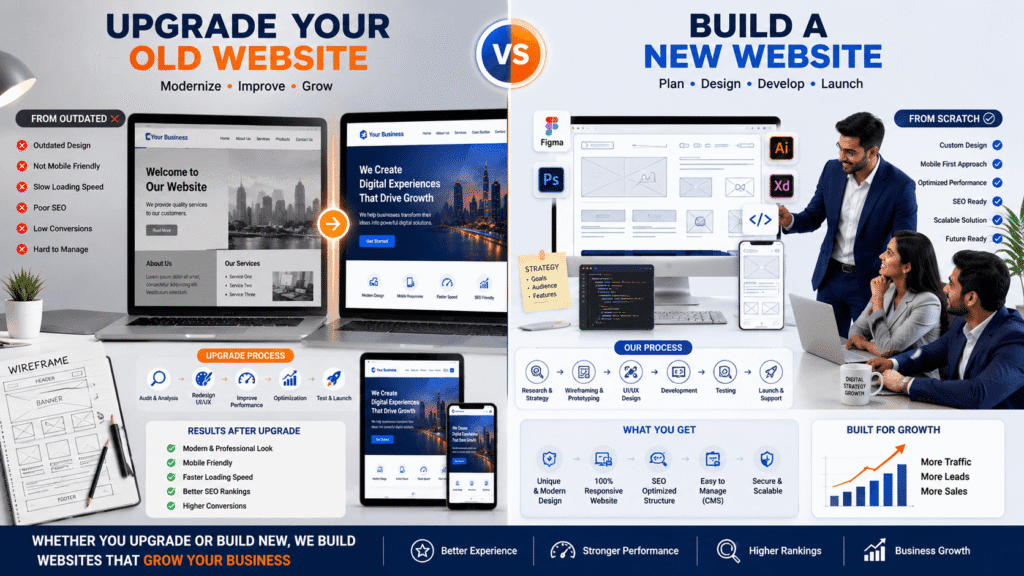
Understanding Website Redesign
A website redesign involves improving and updating your existing website while retaining some of its core structure.
A redesign may include:
- Modernizing the design
- Improving user experience
- Updating branding
- Optimizing for mobile devices
- Improving page speed
- Enhancing SEO performance
- Updating content and images
Businesses often choose professional website redesign services when their current website still has a solid foundation but needs modernization.
What Is a New Website?
A new website is built from scratch.
Instead of modifying the existing website, developers create an entirely new structure, design, and functionality based on current business needs.
This typically includes:
- New design system
- New page structure
- New content strategy
- Updated technology stack
- Improved functionality
- Modern SEO architecture
A new website provides complete flexibility and eliminates limitations created by older systems.
Signs You Need a Website Redesign
In many cases, a redesign is enough to improve performance and achieve business goals.
Here are some signs a redesign may be the right choice:
Your Website Looks Outdated
An old design can make visitors question your credibility.
Updating layouts, typography, colors, and imagery can significantly improve first impressions.
Your Website Is Not Mobile-Friendly
If your website doesn’t perform well on smartphones and tablets, a redesign can help create a responsive user experience.
Your Branding Has Changed
Businesses often update:
- Logos
- Colors
- Messaging
- Service offerings
A redesign ensures your website aligns with your current brand identity.
Your Website Loads Slowly
Slow websites frustrate users and negatively impact search rankings.
A redesign can improve performance through:
- Image optimization
- Code improvements
- Better hosting configurations
You Want Better Conversions
Improved call-to-action placement, landing pages, and user journeys can increase lead generation without rebuilding the entire website.
Signs You Need a New Website
Sometimes a redesign isn’t enough.
Building a completely new website may be the smarter investment when major issues exist.
Outdated Technology
If your website uses unsupported software, outdated frameworks, or obsolete systems, starting fresh is often more cost-effective.
Poor Website Structure
Many older websites were built without considering modern SEO and user experience principles.
Problems may include:
- Confusing navigation
- Poor page hierarchy
- Broken internal linking
- Duplicate content issues
Major Business Changes
If your business has evolved significantly, your existing website may no longer represent your company.
For example:
- New services
- New target audience
- New business model
- Expansion into new markets
A new website allows you to rebuild around your current goals.
Security Concerns
Older websites can become vulnerable to security threats.
A new website often provides:
- Better security practices
- Updated software
- Improved hosting compatibility
Poor Performance Despite Updates
If you’ve repeatedly patched and updated your website without seeing improvements, rebuilding from scratch may provide better long-term results.
Website Redesign vs New Website: Key Differences
Cost
Website Redesign
Typically costs less because existing assets can be reused.
Suitable for:
- Small businesses
- Local service providers
- Businesses with functional websites
New Website
Usually requires a larger investment because everything is rebuilt.
Suitable for:
- Growing businesses
- Established companies
- Businesses requiring advanced functionality
Time Required
Redesign
A redesign generally takes less time because existing content and structure can often be retained.
New Website
Building a new website takes longer because planning, design, development, content migration, and testing must be completed from the ground up.
Flexibility
Redesign
Provides moderate flexibility while preserving existing infrastructure.
New Website
Offers complete creative and technical freedom.
Developers can create a website optimized for:
- SEO
- Speed
- User experience
- Scalability
SEO Impact
Redesign
A properly planned redesign can improve SEO while preserving existing rankings.
Benefits include:
- Faster load times
- Better user experience
- Improved mobile responsiveness
New Website
A new website offers opportunities to implement a stronger SEO foundation but requires careful migration planning.
Businesses should ensure:
- URL redirects are implemented
- Existing rankings are protected
- Content is properly migrated
When a Website Redesign Makes Sense
A redesign is often the better option if:
- Your website is less than five years old
- Your content is still relevant
- Your website receives traffic
- The underlying platform remains reliable
- You mainly need visual and performance improvements
For many businesses, redesigning an existing website provides excellent results while keeping costs manageable.
When Building a New Website Makes Sense
A new website is often the better choice if:
- Your website uses outdated technology
- The user experience is poor
- The site structure is broken
- Your business has changed significantly
- Security issues exist
- Future scalability is important
In these situations, rebuilding often saves money over the long term by eliminating recurring problems.
Cost Comparison in India (2026)
Website Redesign Costs
Typical range:
₹10,000 – ₹80,000+
Depending on:
- Number of pages
- Design complexity
- SEO requirements
- Content updates
New Website Costs
Typical range:
₹20,000 – ₹2,00,000+
Depending on:
- Custom functionality
- Design requirements
- E-commerce integration
- Advanced features
Businesses can explore professional website designing services to determine the best solution for their specific needs.
Questions to Ask Before Making a Decision
Before choosing between a redesign and a new website, ask yourself:
Is My Current Website Generating Leads?
If yes, preserving existing strengths through a redesign may be beneficial.
Does My Website Support Current Business Goals?
If not, rebuilding may provide a better long-term solution.
Is My Website Easy to Maintain?
If updates are difficult or expensive, a new website may improve efficiency.
Am I Planning Future Growth?
A scalable website becomes increasingly important as your business expands.
Frequently Asked Questions
Is website redesign cheaper than building a new website?
In most cases, yes. A redesign usually costs less because existing assets and content can be reused.
How often should a business redesign its website?
Most businesses should evaluate redesign opportunities every 3–5 years to stay competitive and maintain a modern user experience.
Will a website redesign improve SEO?
Yes. A redesign can improve page speed, mobile responsiveness, user experience, and technical SEO factors.
Can I keep my existing content during a redesign?
Absolutely. Many businesses retain and update existing content while improving design and functionality.
How do I know if I need a new website instead of a redesign?
If your website has outdated technology, structural issues, security problems, or no longer supports your business goals, building a new website is often the better option.
Conclusion
Choosing between a website redesign and a new website depends on your business goals, budget, and the condition of your existing website.
If your website has a strong foundation and simply needs visual improvements, performance enhancements, and better user experience, a redesign may be the ideal solution.
However, if your website suffers from outdated technology, poor structure, security concerns, or major limitations, investing in a new website can provide better long-term value.
The right decision should focus on creating a website that attracts visitors, builds trust, generates leads, and supports your business growth well into the future.
If you’re unsure which option is best for your business, consulting with experienced web professionals can help you evaluate your current website and identify the most effective path forward.